
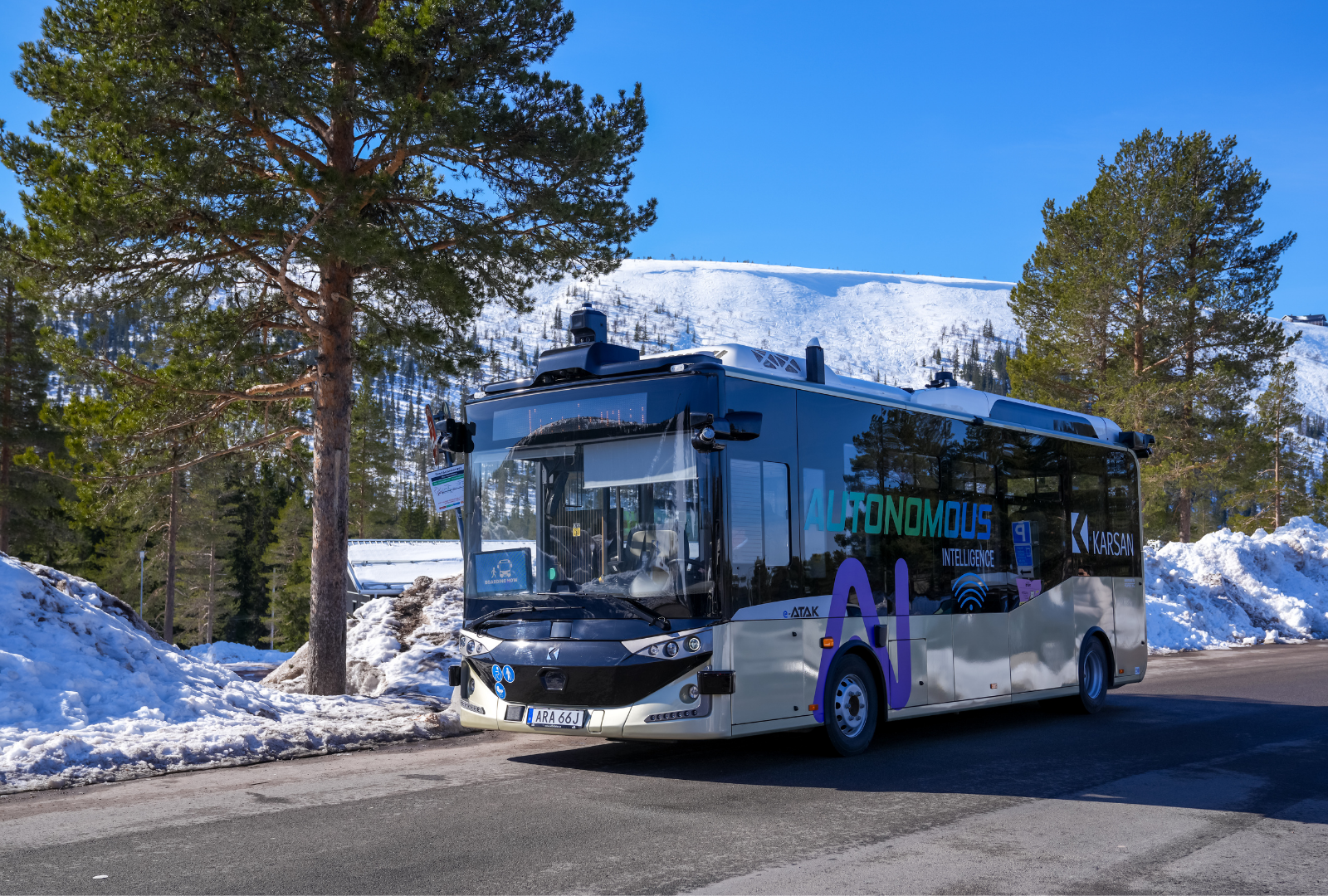
One of the First Automated Public Transportation Applications in Ski Tourism!
SÄLEN, Sweden — Karsan Autonomous e-ATAK, automated by ADASTEC is deployed in Sälen, Sweden, as part of a high-complexity mobility project designed for winter tourism environments.
“With the Sälen deployment, we have successfully tested and validated our automated driving technology in real winter conditions. Building on our experience across more than 12 countries, this project proves that our system can operate safely and reliably not only in urban environments, but also in ski resorts with snow, low temperatures, and continuous interaction with pedestrians and skiers.” said Dr. Ali Peker, CEO of ADASTEC.
Covering a total route length of 4.8 km, the system connects ski centers and accommodation areas under challenging operational conditions, including snow-covered roads, low temperatures, sloped terrain, and dense pedestrian and skier traffic. Operatingin mixed traffic and shared spaces, the deployment demonstrates that automated public transport is no longer limited to pilot programs, but represents a safe, approved, and scalable solution for real-world public transportation, even in one of the most challenging operational environments.
As part of a structured research and development program, the deployment also serves as a real-world validation of automated driving technology in winter conditions. The project enables testing and validation of system performance under snow, ice, and low-temperature scenarios, while supporting safe passenger transport operations.
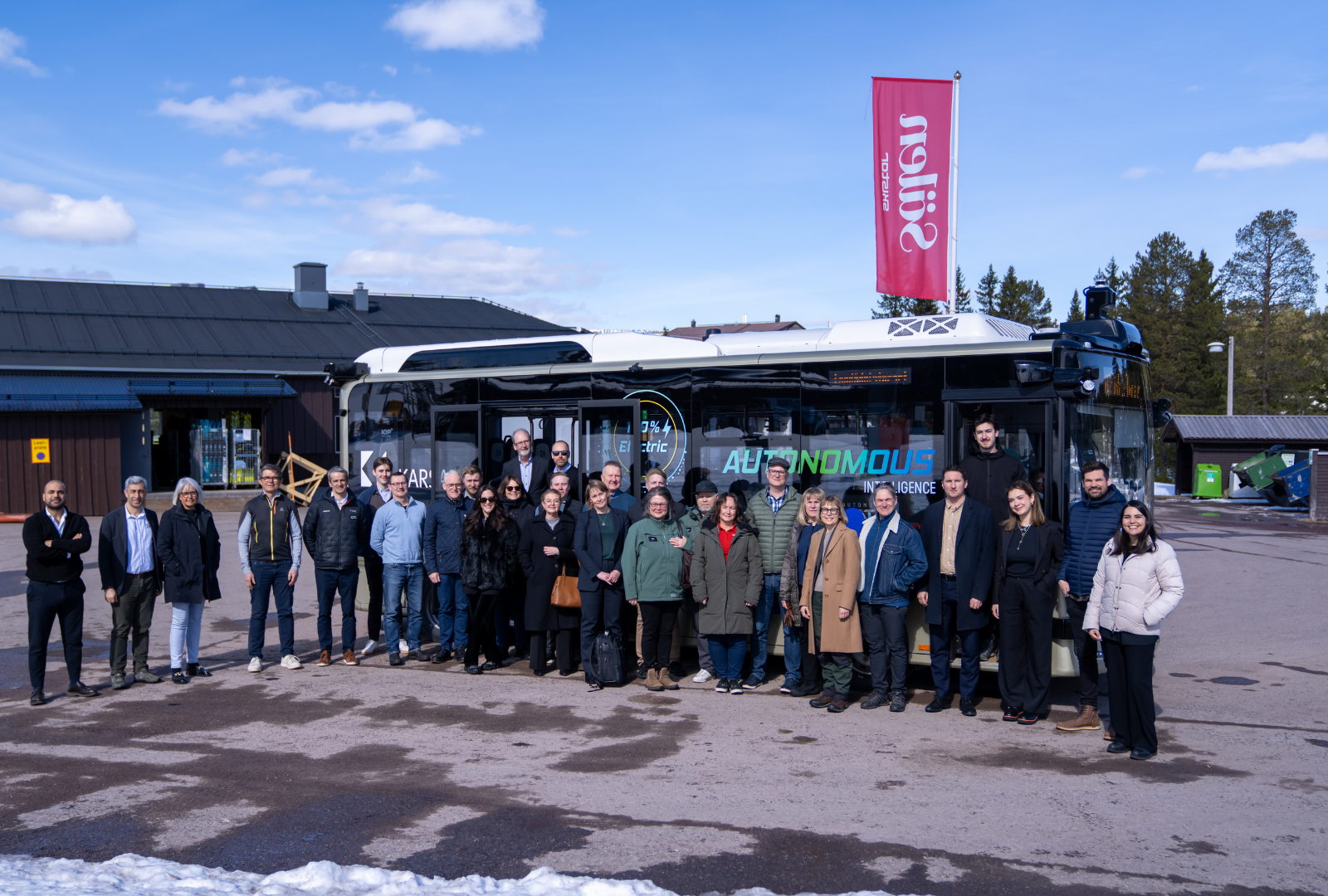
A Benchmark Deployment in Complex Winter Conditions
This deployment represents one of the first implementations of automated public transport in a ski resort context, positioning Sälen as a benchmark for high-complexity environments where dynamic human interaction and harsh weather conditions intersect.
The project has received passenger transport approval from Transport Styrelsen, validating the system’s safety, reliability, and readiness for real passenger operations. The approval confirms the system’s ability to operate under complex environmental and traffic conditions while maintaining consistent performance and safety standards.
Built on Karsan and ADASTEC’s proven global deployment experience, the Sälen project leverages operational knowledge gained across more than 12 countries and diverse geographies, climates, and use cases. The system has been continuously refined through real-world deployments, including challenging environments such as Michigan State University, Stavanger, and Finland, where adverse weather conditions have played a critical role in strengthening system performance and reliability.
“The test demonstrates the potential of autonomous public transport in winter conditions — while we have already learned an incredible amount, both to improve the technology and to refine the project’s operational procedures,” says project manager Tiina Ohlsson from Malung-Sälen Municipality.
The Karsan Autonomous e-ATAK, automated by ADASTEC, is designed to operate reliably in extreme winter conditions, including snow, ice, and low temperatures, while maintaining safe interaction with pedestrians, skiers, and other road users in high-density shared environments. The deployment highlights the system’s ability to navigate complex road geometries and dynamic operational scenarios typical of mountainous resort areas.
In addition to operational performance, the project contributes to sustainable tourism by enabling zero-emission public transportation tailored to resort environments.It supports regional sustainability goals while ensuring efficient mobility services during peak seasonal demand.
Karsan CEO Okan Baş stated, “This project clearly demonstrates that autonomous mobility is no longer limited to controlled test environments but can be deployed safely and sustainably even under challenging geographical and climatic conditions. The success we achieved in Sälen proves that autonomous public transport has evolved into a scalable mobility solution, paving the way for wider adoption across different use cases, particularly in tourism regions.
As Karsan, we remain committed to making autonomous mobility a part of everyday life. The strong performance delivered in Sälen not only highlights the maturity of autonomous public transport in real operational conditions, but also establishes a solid benchmark for similar winter tourism destinations.
The successful realization of this project stands as a strong example of the value created through close collaboration. Our partnership with Malung-Sälen Municipality, Sälen Buss, Dalarna University, Applied Autonomy team, SkiStar and our technology partner ADASTEC has been instrumental in achieving this outcome, clearly demonstrating the critical role of multi-stakeholder collaboration in advancing next-generation mobility solutions.”
A Scalable Model for Resort Mobility Infrastructure
The deployment is part of the SIKTA (Sälen–Idre Collective Transport Autonomous) project, running from January 2025 to December 2027, led by Malung-Sälen Municipality in collaboration with Älvdalen Municipality, local businesses, and Dalarna University.
The project reflects a broader vision to establish scalable automated mobility infrastructure in leisure and tourism destinations. The Sälen deployment is positioned as part of a long-term mobility transformation rather than a one-off implementation.
Following operations in Sälen, the vehicle is planned to continue deployment in Idre, another major winter tourism destination in Sweden, as the next phase of the project, further expanding automated public transport services within the region.
“Sälen marks an important step in testing and proving our technology in a ski resort environment. Building on our experience in winter conditions, this deployment has enabled us to further adapt our system to the specific dynamics of winter tourism. As we continue operations in Idre, we will carry these learnings forward and further expand our experience in resort environments.” said Dr. Ali Peker.
The Sälen deployment highlights the growing maturity of automated public transport in real-world ski resort environments. It establishes a strong foundation for expanding automated mobility across similar winter tourism destinations.