
Proven and Authorized for Scalable Operations on Dedicated BRT Corridors
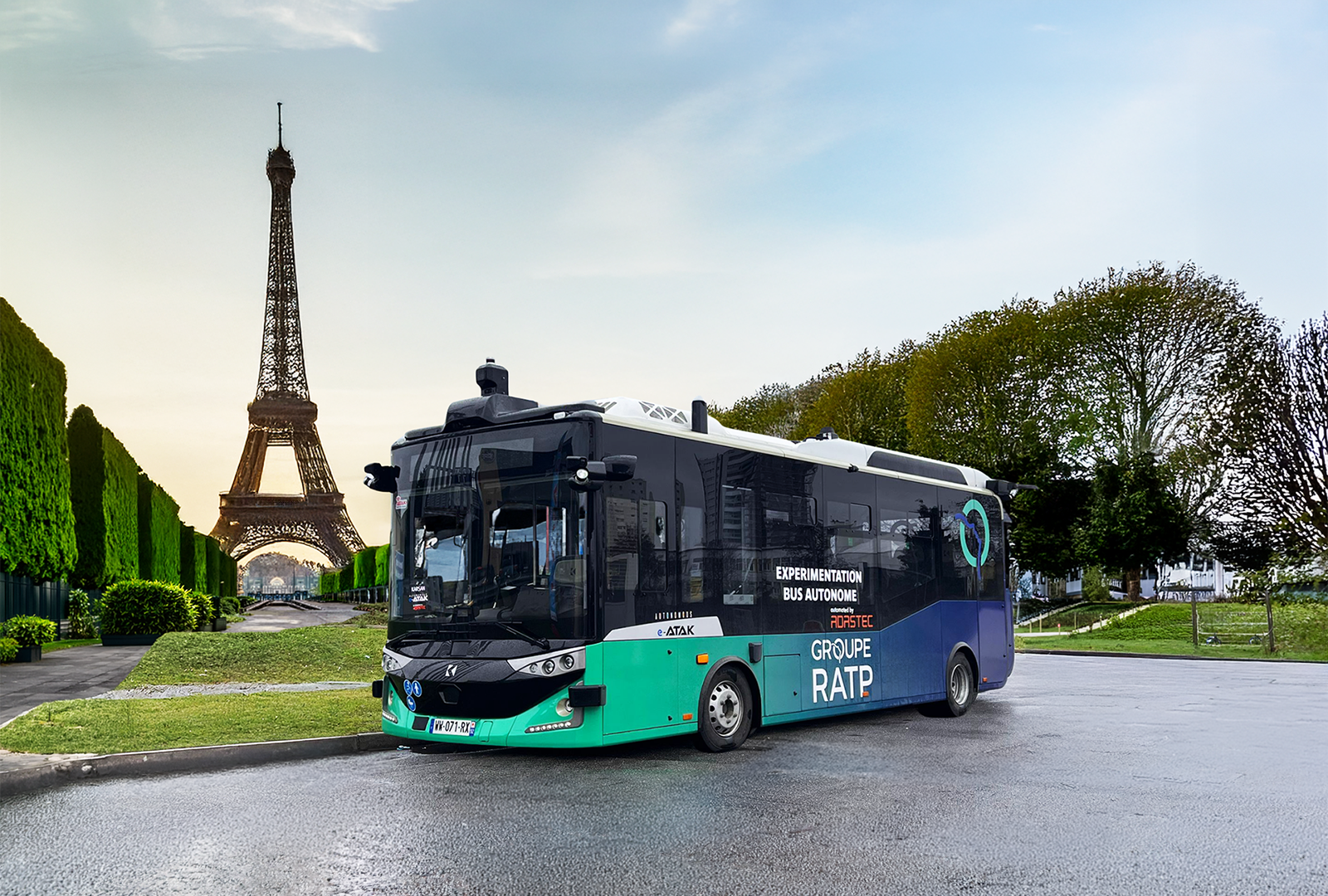
Paris, France —ADASTEC, a global leader in SAE Level-4 automated driving software for public transit, announces the successful completion of a six-month operation on Route 393 in the Paris metropolitan area with the Karsan Autonomous e-ATAK, automated by ADASTEC.
“Deploying automated bus operations on dedicated BRT corridors requires advanced and reliable technology capable of operating consistently in real-world conditions,” said Dr. Ali Peker, CEO of ADASTEC. “With this deployment, we have delivered a proven and scalable automated driving solution designed for continuous operation in live public transport environments. Together with Karsan and RATP, we have established a strong foundation for scaling automated public transport systems on BRT corridors as part of daily urban mobility.”
Delivered in close collaboration with RATP (Régie Autonome des Transports Parisiens) and Karsan, the deployment marks an important advancement in the deployment of automated public transport systems on dedicated BRT corridors across Europe.
The vehicle operated along a 8.3-kilometer Bus Rapid Transit (BRT) corridor with dedicated lanes, while also managing transitions into open traffic environments. Throughout the operation, the system delivered stable and consistent performance in real urban conditions, including interactions with vehicles, pedestrians, traffic lights, and intersections.
Proven Technology in Continuous Operation
Over the course of the deployment, Karsan Autonomous e-ATAK completed more than 3,000 kilometers of automated driving, maintaining an average of five hours of daily operation. ADASTEC’s flowride.ai, SAE Level-4 automated driving software platform achieved a 98% success rate without driver intervention, confirming the maturity and reliability of the technology under continuous real-world conditions.
Operating along Line 393 and serving 14 bus stops, the system delivered stable and consistent performance throughout daily service. Positioned as a proven ADS technology provider, ADASTEC’s SAE Level-4 automated driving software platform, factory-integrated into the Karsan Autonomous e-ATAK, enabled precise station docking, smooth navigation across mixed traffic scenarios, and real-time decision-making in complex urban environments. Supported by V2X communication with infrastructure, the system was able to interact with traffic signals and corridor elements in real time, further enhancing operational safety and efficiency. The system maintained consistent operational performance throughout the deployment, supporting the demands of daily public transport service.
Scalability Proven on Dedicated BRT Corridors
The operational results achieved on Route 393 confirm the scalability potential of automated bus systems, particularly on dedicated BRT corridors, where structured infrastructure enables efficient, repeatable, and high-capacity operations.
Through consistent performance in real-world conditions, ADASTEC’s automated driving technology has validated its ability to support the transition from single-vehicle deployment toward scalable public transport operations. The controlled environment of BRT systems, combined with advanced automated driving capabilities, provides a strong foundation for expanding automated mobility solutions across urban networks.
Karsan CEO Okan Baş stated, “Our vehicle demonstrated its operational capabilities by successfully testing advanced driving scenarios such as navigation in mixed traffic conditions, precise parking at stops, and real-time interaction with traffic lights and intersections. “During the six-month testing period, the vehicle achieved a 98% success rate in autonomous driving without driver intervention. This rate serves as concrete proof of the high reliability and operational maturity of our autonomous solution,” he said.
Authorized for Real-World Operations in France
Karsan Autonomous e-ATAK, automated by ADASTEC successfully fulfilled the regulatory and operational requirements defined by French authorities and was authorized by the French Ministry of Transport for operation in real traffic conditions.
As part of the deployment, extensive testing activities were conducted on a dedicated test track at UTAC, France’s independent vehicle testing facility, supporting the validation of system performance under controlled conditions prior to real-world operations. These activities, carried out in coordination with RATP, contributed to the overall readiness of the system for deployment in public transport service.
Following this process, the authorization granted by the French Ministry of Transport confirmed that the Karsan Autonomous e-ATAK meets the necessary safety, performance, and operational criteria for use on public roads.
This achievement confirms that the Karsan Autonomous e-ATAK, automated by ADASTEC, delivers compliant, deployable, and scalable automated bus solutions. These solutions are ready for integration into existing public transport networks within country-specific regulatory frameworks.
Towards Fully Driverless Operations on BRT Corridors
The successful completion of operations in Paris establishes a strong foundation for the next phase of automated public transport deployments, where scalability and full autonomy become central to system design. The results achieved on Route 393 highlight the critical role of dedicated BRT corridors in enabling structured, repeatable, and high-capacity automated operations.
Dedicated BRT corridors provide controlled environments, defined routes, and infrastructure readiness. These characteristics create the ideal conditions for scaling SAE Level-4 automated driving solutions from initial deployments to fleet-level operations. This positions BRT corridors as a key enabler in the transition toward fully automated public transport networks.
Building on this foundation, the Karsan Autonomous e-ATAK, automated by ADASTEC, continues to advance toward fully driverless operations, where the safety driver is no longer required. Karsan Autonomous e-ATAK has already been operating in real-world service for over five years in Norway, establishing a strong baseline for fully automated operations. The deployment in Paris builds on this experience, marking a further step in validating performance on a dedicated BRT corridor under a new operational and regulatory context.
“Dedicated BRT corridors create the right operational environment to scale automated driving systems efficiently and reliably,” said Dr. Ali Peker, CEO of ADASTEC. "Our focus is to enable a fully automated operational model, where fleets can operate safely and continuously without the need for a safety driver, supporting the future of high-capacity urban mobility.”