
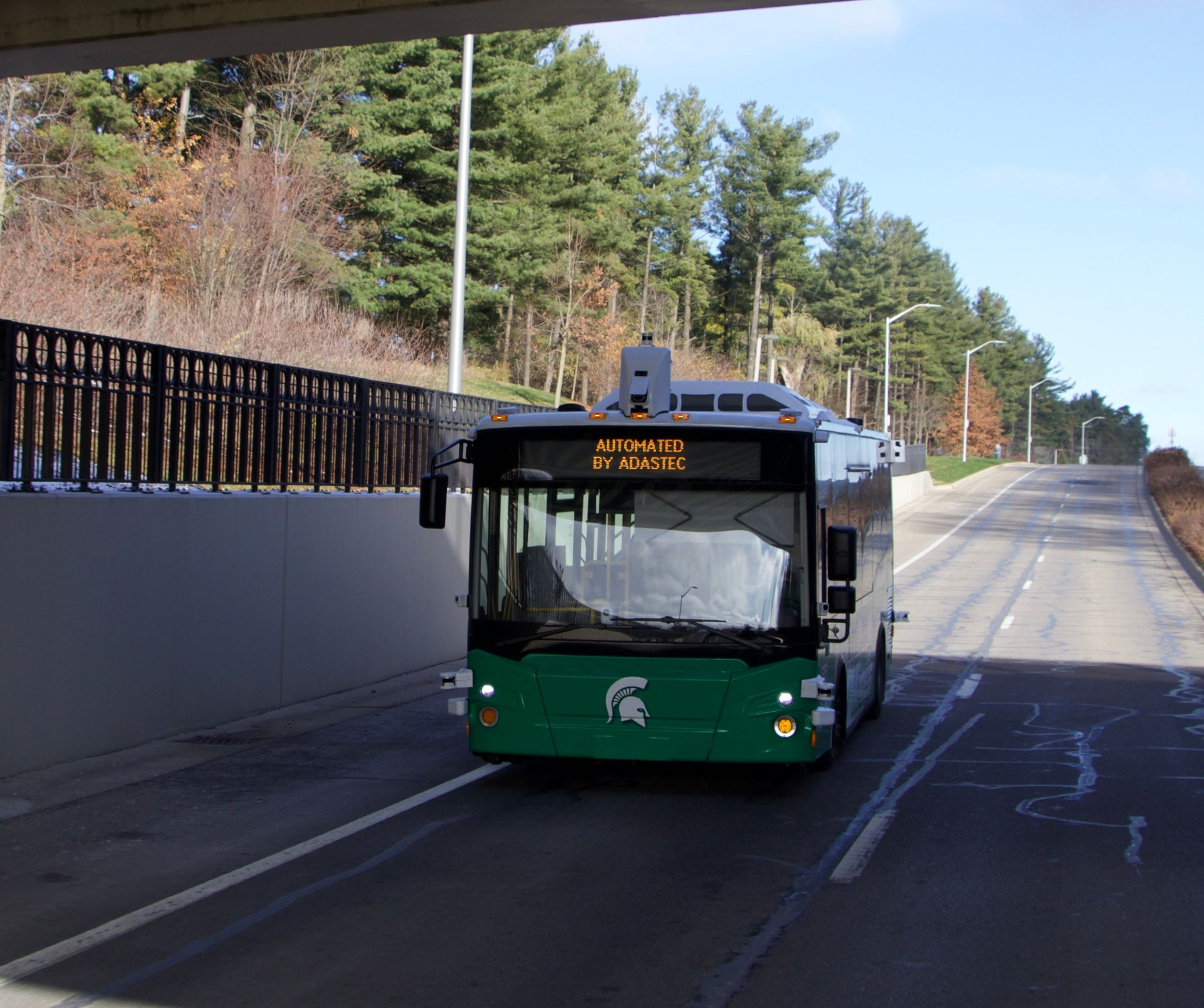
Automated Bus Service at Michigan State University
ADASTEC is delivering the first SAE Level-4 automated bus in the United States to operate on open public roads with full Buy America, FMVSS, and ADA-compliance. Developed and operated in collaboration with Michigan State University (MSU), the service integrates ADASTEC’s proven SAE Level-4 automated driving software platform, flowride.ai, into the university’s daily transportation network, providing a safe, accessible, and sustainable mobility option for students, faculty, staff, visitors, and the surrounding community.
The service operates along a 4.95-mile (7.9 km) fixed campus route, connecting key destinations including Commuter Lot 89 – 2, Commuter Lot 89 – 4, Wilson Road, Anthony Hall, Wharton Center Loop, IM East, and the Natural Resources building. Passenger service runs Monday through Friday between 10:05 a.m. and 3:25 p.m., providing consistent links between commuter parking, academic facilities, residence halls, and cultural venues.
The route presents a variety of operational challenges, including crosswalks, bicycle lanes, bus terminals, and two uncontrolled left turns. It passes through high pedestrian and cyclist traffic areas, requiring precise navigation and continuous interaction with mixed urban traffic. The maximum operating speed is 25 mph, and the system is capable of complex maneuvers such as side and parallel parking, station docking, and lane changes in active traffic.
Nine C-V2X roadside units installed along the route enable continuous Vehicle-to-Infrastructure (V2I) communication. This connectivity allows the vehicle to interpret SPaT and MAP messages from 13 traffic lights, enabling optimized signal coordination for improved safety and efficiency at intersections and pedestrian crossings.
The bus is factory-fitted with ADASTEC’s advanced sensor suite, including LiDARs, radars, RGB cameras, a GNSS unit, and a C-V2X onboard unit. flowride.ai integrates perception, localization, and planning capabilities, managing all driving functions without human intervention on the pre-mapped route. The system continuously processes real-time environmental and infrastructure data to ensure safe, precise decision-making in a wide range of weather and traffic conditions, including light snow, rain, and haze.
The vehicle features an automated accessibility ramp and ADA-compliant boarding, ensuring inclusive service for passengers with reduced mobility. Real-time fleet monitoring and remote operation capabilities provide additional operational assurance, enabling rapid intervention when required.
Timetable for Passenger Service at Michigan State University
Passenger service operates Monday through Friday with regular departures every ~50 minutes from Commuter Lot 89-2.
Daily Departure Times:
- 10:05 a.m.
- 10:55 a.m.
- 11:45 a.m.
- 12:55 p.m.
- 1:45 p.m.
- 2:35 p.m.
This schedule provides consistent connections between commuter parking areas, academic facilities, residence halls, and cultural venues across the MSU campus. For more detailed specifications and technical information, please visit the Fact Sheet.
This service builds on ADASTEC’s earlier collaboration with MSU, which began in 2022 with the first U.S. deployment of a full-size automated bus in passenger service. The current phase expands the operational footprint, integrates advanced connected vehicle technologies, and continues as part of a three-year research agreement. The service functions as both a transportation solution and a living research platform, generating continuous operational data to advance connected and automated mobility development.
By combining advanced automation, connected infrastructure, and full regulatory compliance, ADASTEC is demonstrating the readiness and scalability of its factory-fitted SAE Level-4 technology in a university environment. The Michigan State University service highlights how automated public transportation can operate reliably, inclusively, and efficiently in complex, real-world conditions, providing immediate community benefits while contributing to the future of intelligent mobility in the United States.